We only recommend products that we use and believe in. When you purchase through links on our site, we may earn an affiliate commission.
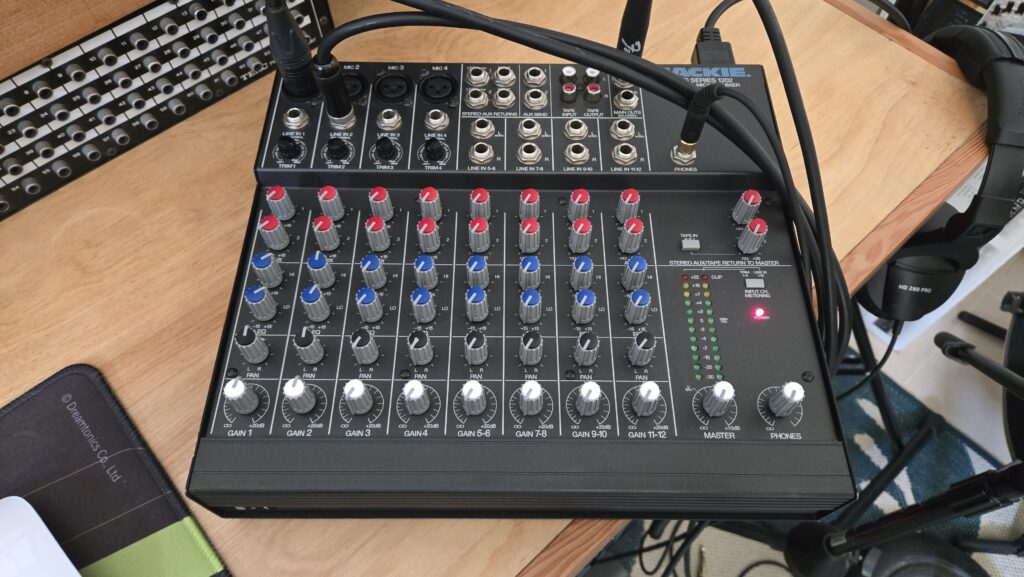
Known for its built-like-a-tank construction, is the Mackie 1202 from 1992 even worth considering in 2026?
I found one of these mixers at an estate sale – a great place to shop for vintage audio gear – for the affordable price of $17.50. Although undamaged and accompanied with all of its knobs and a power cord, it sported a thick layer of caked-on crusty dust and a small Dymo label “B-1” on the front face. Plugged in the power, flipped the switch and the power light displays a satisfying red glow. So far so good.
First Sound Test
Got it home, fired it up, plugged in a mic, and…what is that horrendous hum? Not a hiss, but a loud 120HZ hum with all knobs on zero. Oh well – sell it on eBay for parts. Totally disappointed, I stashed it in the corner of my office closet to attend to later.
As Time Goes By
Several months went by and an occasion was coming up that required a mixer. Could the Mackie have repaired itself in the dark of that closet? No! The hum is still there. Then the phone rang and I left the 1202 turned on while I chatted, put the headphones back on, and, no more hum. Wow! It did fix itself. I knew this probably wasn’t the case, so I asked my AI friend and he came back with this diagnosis:
That specific symptom—a 120 Hz hum that gradually disappears as the unit warms up—is a classic indicator of failing electrolytic filter capacitors in the power supply section.
Since the hum is 120 Hz (double the standard 60 Hz line frequency), it confirms the noise is coming from the full-wave rectified DC power rails rather than simple AC induction or a ground loop.Mr. AI
DIY Repair or Sell?
Honestly, sending it to a shop for repair ($150 plus parts in my city) doesn’t make sense unless you are in love with the 1202s specific sound and function. You could sell for parts and buy a newer similar mixer. But I like a challenge, and we’re talking about $2.28 for the capacitors. So I repaired it myself, and it now works better than new.
The 1202s “viability” depends entirely on your needs. For pure analog summing, live utility, or adding specific harmonic grit, it remains a “toolbox” staple. However, compared to modern digital-integrated mixers, its raw technical specs show its age.
Spec Comparison: Micro Series 1202 vs. Modern Standards (2026)
While the 1202 was groundbreaking in 1992, modern successors like the Mackie 1202VLZ4 or similar digital mixers have pushed technical boundaries significantly.
Micro Series 1202 (Original) Modern Standard (e.g., 1202VLZ4) Preamps: Original Discrete (Warm/Muddier) Preamps: Onyx Preamps (Transparent/Low Noise) Dynamic Range~90 dB S/N Ratio Dynamic Range128.5 dB Dynamic Range Freq. Response 20Hz – 40kHz Freq. Response 20Hz – 100kHz (+0/-3dB) Distortion (THD)< 0.025% Distortion (THD)< 0.0007% EQ Points: 2-band fixed low/high shelving EQ Points: 3-band with High/Mid/Low shelving Build Quality: USA-made, indestructible steel Build Quality: Robust, but often Chinese-made
Why It Still Works (The “Pro” Side)
- Indestructibility: Known to survive fires, spills, and extreme physical trauma while remaining functional.
- Creative Distortion: Unlike modern transparent preamps, the original 1202 has a “sound”—it distorts in a way many 90s electronic and lo-fi producers still value.
- Analog Routing: Features like the Alt 3/4 bus (activated by the Mute button) allow for clever signal rerouting to samplers or audio interfaces.
- Headphone Amp: The headphone amp is super loud and sounds good.
Why You Might Skip It (The “Con” Side)
- Aging Components: In 2026, most units are over 30 years old. You will likely face scratchy pots, oxidizing switches, and power supply capacitors that need replacement.
- No Digital I/O: It lacks USB connectivity, meaning you still need a separate audio interface to record into a DAW.
- Harshness: Some find the original mic preamps “thin” or “harsh” compared to the smoother response of modern boutique or high-end interface preamps.
Where to buy:

Current Market Value
Used units typically sell for $90 to $150 depending on condition. You can find them at retailers like Guitar Center or Music Go Round and of course, eBay and Reverb.
About The Author