MikesGig features affiliate links to help support our content. At no cost to you, we may earn a commission on affiliate purchases.
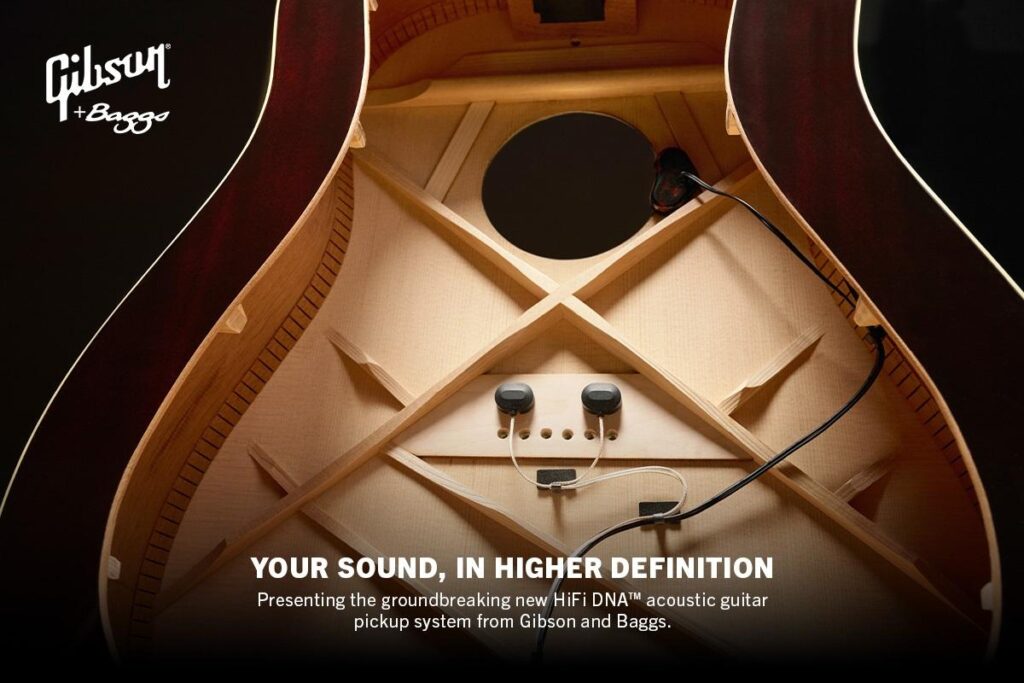
Instead of blending two sensors before amplification, the new HiFi DNA system gives each sensor its own discrete Class A preamp channel—then combines the signals for a more detailed, feedback-resistant amplified acoustic sound.
Most acoustic pickups begin with a compromise.
You want detail—But you also need feedback resistance.
You want body resonance—But you need the attack to stay clear.
You want an acoustic guitar to sound like an acoustic guitar—But you need it loud enough to survive a stage.
Gibson and Baggs are taking a different technical approach with the new HiFi DNA pickup system.
The goal is ambitious:
Bring the sound of a more complete acoustic-guitar capture to a stage-ready pickup platform.
HiFi DNA is now available on select Gibson acoustic guitars across the Modern and Original Collections. A standalone aftermarket version is planned for future release.
The key idea: two sensors, two preamp channels
The most important technical feature is not simply that HiFi DNA uses two sensors.
It is what happens next.
In many multi-source pickup systems, the signals are summed together before amplification.
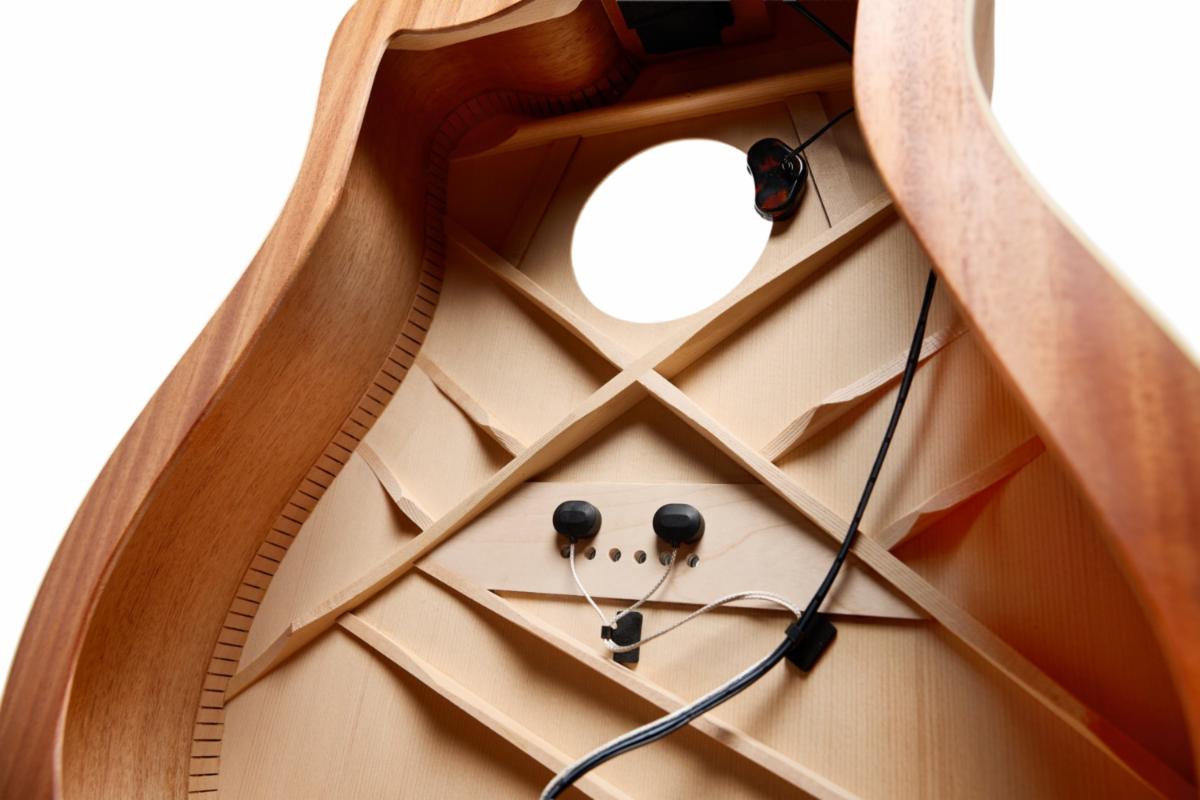
HiFi DNA gives each sensor its own independently optimized, all-discrete Class A preamp stage before blending the signals.
Think of it like recording two microphones through two separate preamp channels.
Each source retains its own signal integrity before the engineer decides how the two channels should work together.
With HiFi DNA, the blending happens after the individual signals are amplified.
That is designed to reduce unwanted interaction between the two sensor elements.
Why summed pickup signals can get muddy
When two piezo-style sensing elements are tied together before amplification, they can influence each other electrically.
That interaction can affect the frequency response, transient behavior, and sense of separation in the final signal.
Baggs describes it as the sensors “tugging” on one another.
The result can be a less defined sound.
More smear.
Less attack.
Less of the individual guitar’s character.
HiFi DNA’s dual-preamp architecture is designed to prevent that early-stage interaction.
Each sensor sees its own dedicated preamp input.
Each preamp is voiced for that sensor.
Only then are the two channels blended into the final output.
“If you combine two mic diaphragms—or two piezos—before amplification, they tug on each other, and the sound can get muddy.”
— Lloyd R. Baggs, Founder of Baggs
“Separating them preserves every detail.”
— Lloyd R. Baggs
What Class A means here
HiFi DNA uses two custom-voiced, all-discrete Class A preamps.
In practical terms, Class A operation means the active amplification device stays conducting through the full signal waveform rather than switching between positive and negative halves of the waveform.
Designers often choose Class A circuitry for its linear behavior and low crossover distortion.
The tradeoff is usually greater power consumption and heat compared with more efficient amplifier designs.
Inside a guitar pickup system, the point is not raw volume.
It is signal quality.
Baggs’ approach is intended to give both sensors a clean, stable front end before their signals are mixed.
A new sensor platform
Gibson and Baggs say HiFi DNA uses a newly developed sensor platform that is:
- Larger
- Lighter
- More flexible
- More responsive
Less mass and stiffness can help a sensor respond more freely to vibration.
That matters because an acoustic guitar is not one sound source.
The strings create the initial attack.
The top responds.
The bridge transfers energy.
The body and air cavity add resonance.
The player’s touch changes all of it.
HiFi DNA is designed to capture both string detail and body resonance without forcing players to choose between a sharp, pickup-heavy sound and a more spacious but less feedback-resistant microphone sound.
“Less mass and stiffness means more life, more breath, more truth from the guitar.”
— Lloyd R. Baggs
The live-performance problem: gain before feedback
A great studio microphone can capture enormous detail from an acoustic guitar.
It can also become difficult to use when the stage gets loud.
Wedges.
Drums.
Bass amps.
Electric guitars.
Crowd noise.
All of it can push an open microphone toward feedback.
Under-saddle pickups remain popular because they usually offer strong gain before feedback—the amount of usable volume a player can reach before a feedback loop begins.
Gibson and Baggs say HiFi DNA delivers comparable gain before feedback to Baggs’ Element under-saddle pickup.
That is a crucial claim.
It means the system is aimed at players who want a more dimensional sound without losing the practical stability that makes under-saddle systems useful on loud stages.
“Dual sensors with their own independently optimized preamps keep each signal pure and deliver unprecedented fidelity with the same gain before feedback as our acclaimed Element Under Saddle Pickup.”
— Lloyd R. Baggs
HiFi DNA technical overview
| Component | HiFi DNA approach | Why it matters |
|---|---|---|
| Sensor count | Dual sensors | Captures more than one aspect of the guitar’s vibration |
| Preamp topology | Two dedicated, custom-voiced, all-discrete Class A preamps | Amplifies each sensor independently before blending |
| Signal path | Separate sensor channels → separate preamps → blended output | Designed to avoid early interaction between sensor signals |
| Sensor design | Larger, lighter, more flexible platform | Intended to improve responsiveness and capture more detail |
| Target sound | String articulation plus body resonance | Aims for a more complete acoustic-guitar voice |
| Feedback performance | Comparable gain before feedback to Baggs Element under-saddle pickup, according to Baggs | Designed for real-world stage volume |
| Availability | Installed on select Gibson Modern and Original Collection acoustics | Aftermarket standalone version is planned |
What it means for players
HiFi DNA is not trying to turn an acoustic guitar into a microphone.
And it is not trying to turn a pickup into a digital acoustic simulator.
It is a pickup system built around analog signal handling.
Two sensor sources.
Two independent preamp channels.
One blended output.
The result is meant to preserve the guitar’s attack, harmonic detail, dynamic range, and body character while remaining usable through a PA system.
“The first time I heard Lloyd’s new HiFi DNA pickup, I was stunned. It felt like I wasn’t listening from a point in space anymore—I was inside the guitar.”
— Robi Johns, Sr. Product Development Manager, Gibson Acoustic
The MikesGig takeaway
Acoustic guitar amplification has always required tradeoffs.
More volume can mean less realism.
More realism can mean less volume.
HiFi DNA is Gibson and Baggs’ attempt to narrow that gap with a smarter front end.
The technical idea is simple.
Keep both sensors independent while they matter most.
Then blend them into one signal that is ready for the stage.
MikesGig — Gear Moves Music. Music Moves People.
About The Author